


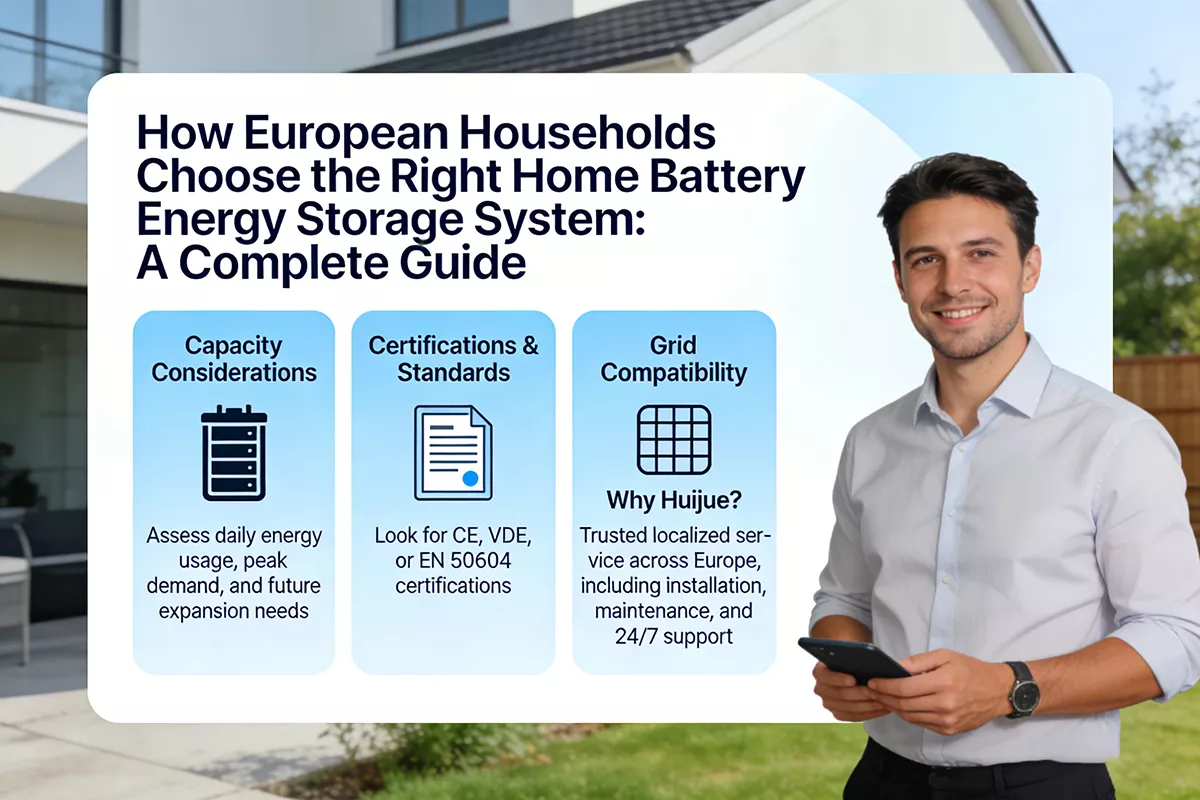
Introduction: The Rise of Home Energy Storage in Europe
Across Europe, electricity prices have surged to record levels. From Germany to Spain, from the Netherlands to Poland, households are increasingly looking for ways to reduce their dependence on the grid, maximize the value of their rooftop solar panels, and secure a stable power supply for their families. The answer for millions of European homeowners is clear: a home battery energy storage system (BESS).
But not all battery storage systems are created equal. Choosing the right one for your home requires careful evaluation of technical specifications, certifications, warranty terms, local service availability, and long-term reliability. In this guide, we walk you through everything a European household needs to know before purchasing a residential BESS — and explain why Huijue has become one of the most trusted energy storage brands for European homeowners.
1. Why European Households Are Adopting Home Battery Storage
The European energy transition is accelerating. By 2030, the EU aims to produce at least 42.5% of its energy from renewable sources. At the household level, this shift is driven by several key factors:
- Skyrocketing electricity costs: Energy prices in Europe have been highly volatile. A home battery lets you store cheap solar energy or low-tariff off-peak electricity and use it when prices are highest.
- Solar self-consumption: Many European countries offer net metering or feed-in tariffs that are declining. Storing your solar surplus and using it at night is now more economically rational than selling it back to the grid.
- Grid resilience: Power outages, while rare in Western Europe, are more common in Eastern and Southern Europe. A BESS provides backup power to keep your home running during outages.
- Carbon footprint reduction: Storing and using renewable energy reduces reliance on fossil-fuel-generated grid power, directly contributing to CO2 reduction goals.
- Government incentives: Countries including Germany, Italy, France, and Austria offer grants and tax relief for residential battery installations.
2. Key Technical Factors to Consider When Choosing a Home BESS
2.1 Battery Capacity (kWh)
Capacity determines how much energy your battery can store. A typical European household consumes between 3,000 and 5,000 kWh per year, which translates to roughly 8-14 kWh per day. For meaningful energy independence, you should aim for a battery with at least 5-10 kWh usable capacity, ideally scalable up to 20 kWh or more for larger homes.
Pro tip: Always pay attention to usable capacity (sometimes listed as DoD - Depth of Discharge), not just the total nominal capacity. A 10 kWh battery with 90% DoD gives you 9 kWh of usable energy.
2.2 Battery Chemistry: LFP vs. NMC
The two main lithium battery chemistries for home storage are:
- Lithium Iron Phosphate (LFP): Safer, longer cycle life (typically 4,000-6,000+ charge cycles), performs better in higher temperatures, and is now the dominant choice for residential BESS in Europe.
- Nickel Manganese Cobalt (NMC): Higher energy density but shorter lifespan and slightly higher thermal risk. Now largely replaced by LFP in home storage applications.
Huijue exclusively uses LFP (Lithium Iron Phosphate) battery cells in its residential energy storage products, ensuring maximum safety, longevity, and performance across European climates.
2.3 Inverter Type: AC-Coupled vs. DC-Coupled
- AC-coupled systems can be added to an existing solar installation without modifying the solar inverter. They offer flexibility but involve slightly more energy conversion losses.
- DC-coupled systems integrate directly with the solar panels via a hybrid inverter, resulting in higher overall system efficiency (up to 97%).
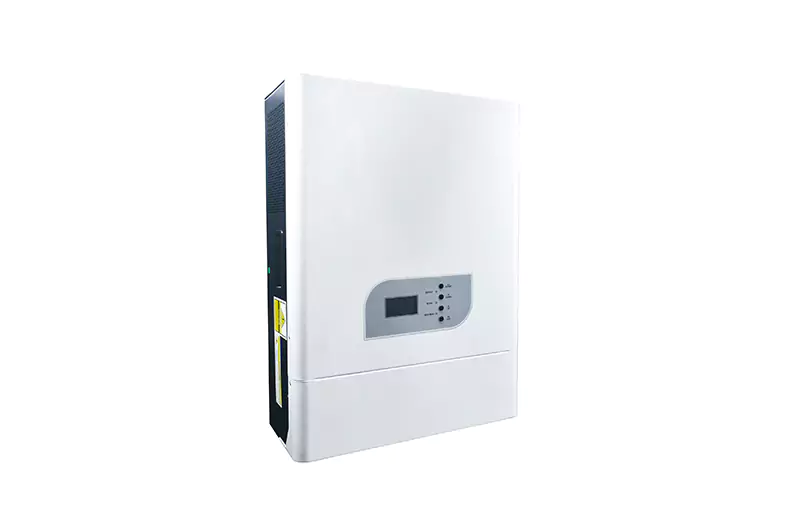
Huijue offers both AC-coupled and DC-coupled home storage solutions, giving installers and homeowners the flexibility to choose the most suitable configuration for each installation.
2.4 Scalability and Modular Design
Your energy needs may grow over time — perhaps you will add more solar panels, purchase an electric vehicle, or heat your home with a heat pump. Choose a BESS that supports modular expansion, allowing you to add battery modules without replacing the entire system.
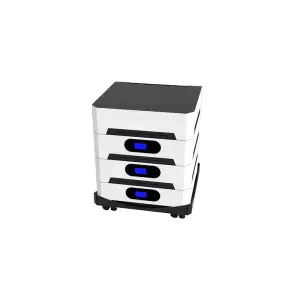
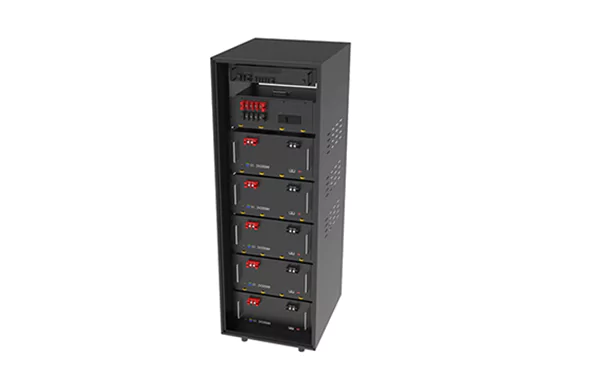
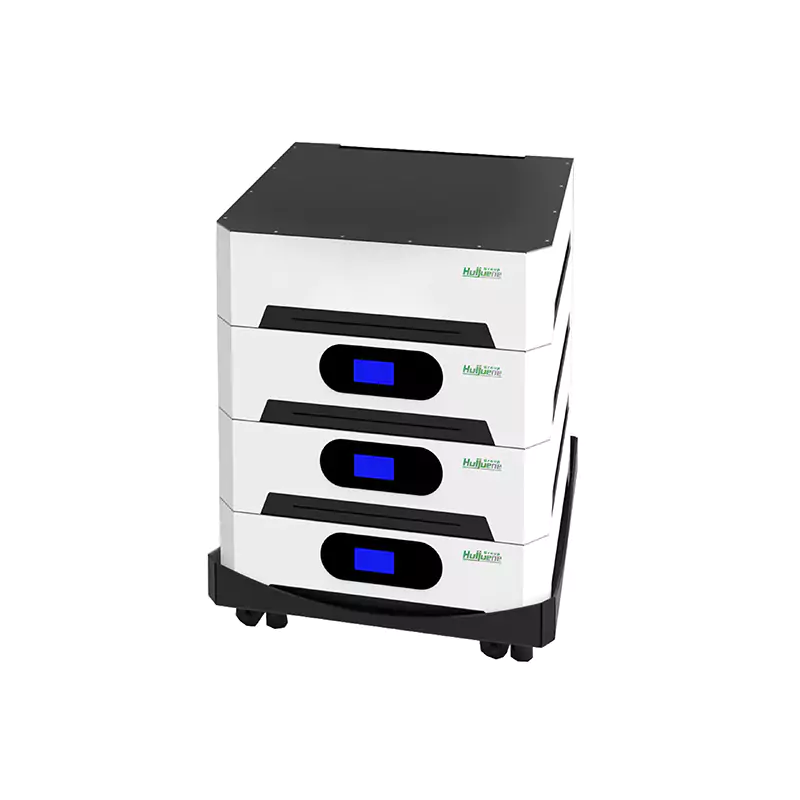
Huijue's residential BESS lineup is designed with scalability at its core. Starting from 5 kWh, systems can be expanded in incremental steps up to 30 kWh or more, all managed by the same intelligent energy management system (EMS).
2.5 Round-Trip Efficiency
Round-trip efficiency measures how much of the energy put into your battery you actually get back. Look for systems with 90% or higher round-trip efficiency. Higher efficiency means less wasted energy and lower operating costs over the system's lifetime.
2.6 Warranty and Cycle Life
A reliable home BESS should offer:
- At least 10 years of product warranty
- At least 4,000 full charge/discharge cycles
- End-of-warranty capacity retention of at least 70%
Huijue backs its home energy storage systems with a 10-year warranty, guaranteeing at least 70% capacity retention at end of warranty period — giving European homeowners genuine peace of mind.
3. Critical Certifications for the European Market
This is one of the most important — and most overlooked — factors when choosing a home battery storage system in Europe. Unlike some markets, Europe has strict regulatory requirements for electrical products. A BESS that lacks the right certifications cannot be legally installed in many European countries and may pose safety risks.
Here are the key certifications you should verify before purchasing any home battery system:
3.1 CE Marking
The CE mark is the minimum legal requirement for any electrical product sold in the European Economic Area (EEA). It confirms that the product meets EU health, safety, and environmental protection standards. Any BESS sold in Europe without CE marking is illegal.
Huijue's entire residential BESS range carries full CE certification.
3.2 IEC 62619 — Safety Requirements for Lithium Batteries
This international standard specifically addresses safety requirements for secondary lithium cells and batteries for use in industrial applications, including stationary energy storage. Compliance with IEC 62619 is increasingly required by European utilities and installers.
3.3 IEC 62040 — UPS Performance Standards
For home BESS systems with backup power functionality, IEC 62040 compliance ensures the system meets performance and safety standards for uninterruptible power supplies.
3.4 UN 38.3 — Battery Transportation Safety
UN 38.3 certification is required for the safe air, sea, and land transport of lithium batteries. This ensures that the battery has passed rigorous testing for altitude simulation, thermal testing, vibration, shock, external short circuit, and overcharge.
3.5 VDE (Germany) / MCS (UK) / UNE (Spain) National Standards
In addition to EU-wide standards, some countries have additional national requirements. Germany's VDE standards are among the most stringent globally. UK installations must use MCS-certified products for eligibility under government incentive programs. In Spain, UNE standards apply.
Huijue actively pursues and maintains all relevant European national and regional certifications, ensuring its products can be installed anywhere across the continent with full regulatory compliance.
3.6 Grid Connection Standards: VDE-AR-N 4105 / EN 50549
Any battery system that connects to the European grid must comply with grid connection standards. In Germany, this is VDE-AR-N 4105; across the EU, EN 50549 sets the requirements for generators (including battery inverters) connected to low-voltage and medium-voltage distribution networks.
Huijue's hybrid and AC-coupled inverters are fully compliant with these grid connection standards across all major European markets.
4. Evaluating After-Sales Service and Local Support
Even the best battery systems require professional installation and occasional maintenance. This is where many overseas manufacturers fall short — they sell products into Europe but lack the local infrastructure to support homeowners when issues arise.
When evaluating after-sales support, ask:
- Does the manufacturer have a local service center or authorized service partners in my country?
- Are spare parts readily available in Europe, or do they need to be shipped from Asia (adding weeks of delay)?
- Is technical documentation and the user interface available in my local language?
- Does the manufacturer offer remote monitoring and remote firmware updates?
- What is the typical response time for warranty claims?
How Huijue Supports European Homeowners
Huijue has made European localization a core part of its business strategy. Unlike companies that simply export products to European distributors and leave local support to chance, Huijue has established:
- Regional offices and warehouses in Europe, enabling fast spare parts delivery across the continent
- A certified installer network in key European markets including Germany, Italy, France, the Netherlands, Poland, and Spain
- Multilingual customer support in English, German, French, Italian, Spanish, Dutch, and Polish
- A localized app and web monitoring platform (available in 10 European languages) that allows homeowners to monitor their system's performance, energy flows, and savings in real time
- On-site warranty service with response times of 48-72 hours in most European countries
- Proactive firmware updates that are pushed over-the-air to optimize system performance and ensure ongoing regulatory compliance
This level of localized support distinguishes Huijue from many competitors and is one of the primary reasons European installers and homeowners continue to choose Huijue products.
5. Understanding the Total Cost of Ownership (TCO)
When comparing home battery systems, it is tempting to focus purely on upfront purchase price. But the total cost of ownership over a 10-15 year period tells a very different story.
Key factors in TCO calculation include:
- Purchase price: Hardware and installation cost
- Degradation rate: A battery that degrades faster will deliver less value over time
- Maintenance costs: Some systems require periodic servicing; others are maintenance-free
- Energy savings: Higher round-trip efficiency = more savings per year
- Incentives and subsidies: Eligible systems may offset a significant portion of the upfront cost
- Replacement costs: Will you need a new battery in 8 years or 15 years?
When evaluated on TCO, Huijue's LFP-based systems consistently deliver outstanding value. With 6,000+ cycle life, minimal degradation, and low maintenance requirements, a Huijue home BESS typically achieves payback in 5-8 years depending on local electricity prices and solar generation — with 5-10 more years of profitable operation ahead.
6. Smart Energy Management: Getting the Most from Your BESS
Modern home battery systems are far more than passive storage tanks. The best systems include intelligent energy management software (EMS) that optimizes energy flows in real time based on:
- Solar generation forecasts (using weather data)
- Household consumption patterns (learned over time via AI)
- Dynamic electricity tariffs (time-of-use pricing)
- Grid signals (including virtual power plant participation)
- Electric vehicle charging schedules
- Heat pump integration
Huijue's proprietary EMS platform, HuijueCloud, integrates all of these elements into a single, easy-to-use interface. European homeowners can set energy priorities, view real-time savings data, receive maintenance alerts, and participate in demand-response programs — all from their smartphone.
7. A Quick Checklist for European Homeowners
Before signing any contract for a home battery installation, use this checklist:
- Does the system use LFP battery chemistry?
- What is the usable capacity (kWh) and Depth of Discharge?
- Is the system CE marked and IEC 62619 certified?
- Does it comply with your country's grid connection standard (e.g., VDE-AR-N 4105 for Germany)?
- What is the cycle life and end-of-warranty capacity guarantee?
- Is the warranty period at least 10 years?
- Does the manufacturer have local service presence in your country?
- Is the monitoring app available in your language?
- Is the system modular and expandable?
- Are government subsidies or incentives available for this product in your region?
8. Why European Homeowners Choose Huijue
Huijue is a globally recognized manufacturer of battery energy storage systems, with a dedicated focus on the European residential and commercial market. Here is what sets Huijue apart:
| Feature | Huijue Advantage |
|---|---|
| Battery Technology | Grade-A LFP cells, 6,000+ cycles, over 80% capacity at end of life |
| Certifications | CE, IEC 62619, IEC 62040, UN 38.3, VDE, MCS, and all major European national certifications |
| Warranty | 10-year product warranty with 70% or higher capacity retention guarantee |
| European Service | Regional offices, local warehouses, certified installer network, 48-72hr on-site response |
| Smart EMS | HuijueCloud platform with 10-language support, AI-powered optimization, VPP integration |
| Scalability | Modular design from 5 kWh to 30+ kWh; compatible with all major solar inverters |
| Grid Compliance | VDE-AR-N 4105, EN 50549, and country-specific grid codes pre-certified |
Conclusion: Make the Smart Choice for Your Home and the Planet
Choosing the right home battery energy storage system is one of the most important investments a European household can make in the coming decade. The right system will cut your electricity bills, protect you from grid outages, reduce your carbon footprint, and potentially increase the value of your home.
But the wrong choice — a system with poor certifications, no local support, or a short cycle life — can be costly and frustrating. Do your homework. Verify certifications. Ask about local service. Think long-term.
If you are looking for a home battery storage system that combines world-class technology, full European regulatory compliance, a comprehensive warranty, and genuine local service — Huijue is the partner you have been looking for.
Ready to explore your options? Contact the Huijue European team today for a free energy assessment and customized BESS proposal for your home.
 Inquiry
 Online Chat